


The Inspire List: The Most Unique Alpine Stays Right Now

Updated: Aug 26

Unique Alpine Stays Redefining Luxury in the Alps
The Alps have long held a special place in Europe’s cultural imagination. Across Switzerland, Italy, and Austria, these mountains form a landscape shaped not only by glaciers and forests, but by centuries of alpine living, craftsmanship, and quiet resilience.
Over the past several seasons, we have returned, navigating valleys and peaks in both winter and summer, to experience a new generation of alpine hospitality taking shape. Some of these places sit directly along the slopes of legendary ski regions. Others are tucked deep within quiet villages or high plateaus where hiking trails, wild meadows, and long summer evenings set the rhythm of the day.
What connects them is character. Each property offers its own interpretation of life in the mountains today: sculptural architecture carved into stone, intimate lodges where gastronomy anchors the experience, wellness sanctuaries overlooking glaciers, and social alpine retreats where design, music, and conversation extend late into the night.
From the architectural clarity of 7132 in Vals to the contemplative calm of eriro in the Austrian Alps, from the vibrant mountain culture of CERVO in Zermatt to the culinary traditions of Rote Wand Gourmet Hotel in Lech, these stays are among the most compelling Alpine destinations we have encountered.
Together, they form our current selection of The Inspire List: The Most Unique Alpine Stays Right Now — places defined by atmosphere, thoughtful design, and the kind of mountain perspective that quietly resets the pace of life.
For anyone interested in planning their own alpine journey, our team at My Inspire Project can also assist with seasonal recommendations and bookings across these exceptional properties.

7132 —
The Alps' Most Important Architecture Retreat
Named after the postal code of the quiet alpine village of Vals, 7132 Hotel stands as one of the most compelling architectural destinations in the Alps. . At its center lies Therme Vals, designed by Pritzker Prize–winning architect Peter Zumthor and constructed from more than 60,000 slabs of locally quarried Vals quartzite. Pools carved into stone chambers transform bathing into an architectural ritual where light, water, and silence shape the experience.
In 2026 the Therme celebrates its 30th anniversary, reaffirming its status as one of the most important works of contemporary spa architecture. Accommodation unfolds across two distinct concepts: the five-star 7132 Hotel with expansive suites, including a penthouse by Kengo Kuma, and the nearby 7132 House of Architects, where rooms by Tadao Ando, Thom Mayne, Kuma, and Zumthor reinterpret alpine design through four distinct architectural languages.
Dining completes the experience. At the Michelin-starred restaurant Silver, alpine ingredients appear in refined tasting menus, while the Cristal Experience offers an intimate chef’s-table pairing of cuisine with rare champagne selections.
7132 remains the Alps’ definitive destination for architecture and bathing culture. 7132 remains the Alps’ definitive destination for architecture and bathing culture. 7132 remains the Alps’ definitive destination for architecture and bathing culture. 7132 remains the Alps’ definitive destination for architecture and bathing culture. 7132 remains the Alps’ definitive destination for architecture and spa culture. 7132 remains the Alps’ definitive destination for architecture and spa culture. 7132 remains the Alps’ definitive destination for architecture and spa culture. 7132 remains the Alps’ definitive destination for architecture and spa culture. 7132 remains the Alps’ definitive destination for architecture and spa culture. 7132 remains the Alps’ definitive destination for architecture and spa culture. 7132 remains the Alps’ definitive destination for architecture and spa culture. 7132 remains the Alps’ definitive destination for architecture and spa culture. 7132 remains the Alps’ definitive destination for architecture and spa culture. 7132 remains the Alps’ definitive destination for architecture and spa culture. 7132 remains the Alps’ definitive destination for architecture and spa culture. 7132 remains the Alps’ definitive destination for architecture and spa culture. 7132 remains the Alps’ definitive destination for architecture and spa culture.
Why it makes our list: With Zumthor’s Therme at its core and one of the most remarkable architectural collaborations in hospitality, 7132 remains the Alps’ definitive destination for architecture and bathing culture.

Six Senses Crans-Montana —
Conscious Alpine Living at Altitude
Set high above the Valais valley with true ski-in ski-out access, Six Senses Crans-Montana introduces the brand’s philosophy of mindful luxury to the Swiss Alps. Timber, stone, and glass architecture open toward panoramic views across the surrounding peaks.
Wellness forms the heart of the property. The expansive Six Senses Spa integrates longevity diagnostics, biohacking treatments, thermal circuits, and a striking indoor-outdoor pool filtered through sand and active carbon, creating a completely chemical-free system.
Sustainability shapes the operation of the hotel. The building operates carbon neutral, and 0.25% of annual revenue supports environmental initiatives, from seed preservation programs to wildlife coexistence projects, including regional wolf conservation.
Dining follows the same philosophy. Wild Cabin focuses on seasonal alpine ingredients, Ora Bar & Lounge moves from aperitivo to evening cocktails, and Byakko, the hotel’s Japanese restaurant, introduces a refined omakase experience to the mountains.
Six Senses Crans-Montana is a sustainable wellness sanctuary in Crans-Montana Six Senses Crans-Montana is a sustainable wellness sanctuary in Crans-Montana Six Senses Crans-Montana is a sustainable wellness sanctuary in Crans-Montana Six Senses Crans-Montana is a sustainable wellness sanctuary in Crans-Montana Six Senses Crans-Montana is a sustainable wellness sanctuary in Crans-Montana Six Senses Crans-Montana is a sustainable wellness sanctuary in Crans-Montana Six Senses Crans-Montana is a sustainable wellness sanctuary in Crans-Montana Six Senses Crans-Montana is a sustainable wellness sanctuary in Crans-Montana Six Senses Crans-Montana is a sustainable wellness sanctuary in Crans-Montana Six Senses Crans-Montana is a sustainable wellness sanctuary in Crans-Montana Six Senses Crans-Montana is a sustainable wellness sanctuary in Crans-Montana Six Senses Crans-Montana is a sustainable wellness sanctuary in Crans-Montana Six Senses Crans-Montana is a sustainable wellness sanctuary in Crans-Montana Six Senses Crans-Montana is a sustainable wellness sanctuary in Crans-Montana Six Senses Crans-Montana is a sustainable wellness sanctuary in Crans-Montana Six Senses Crans-Montana is a sustainable wellness sanctuary in Crans-Montana Six Senses Crans-Montana is a sustainable wellness sanctuary in Crans-Montana Six Senses Crans-Montana is a sustainable wellness sanctuary in Crans-Montana Six Senses Crans-Montana is a sustainable wellness sanctuary in Crans-Montana
Why it makes our list: Six Senses Crans-Montana combines true ski-in, ski-out access, contemporary architecture, advanced wellness programming, and measurable sustainability commitments with high level of coherence. It represents a new chapter of mountain hospitality where elevation, wellbeing, and environmental responsibility evolve together.

CERVO Mountain Resort —
Zermatt’s Most Magnetic Address
On a hillside above Zermatt with the Matterhorn rising directly across the valley, CERVO Mountain Resort has evolved into one of the Alps’ most vibrant mountain destinations. What began as a small lodge has expanded into a collection of chalets and terraces stepping naturally down the mountainside.
Life here extends beyond the ski day. Restaurants and gathering spaces create a lively atmosphere where long lunches transition into sunset cocktails and DJ sessions overlooking the Matterhorn.
Dining anchors the experience. Bazaar brings vibrant eastern Mediterranean cuisine to the Alps, Madre Nostra celebrates Italian cooking, and Ferdinand preserves traditional Valais dishes including fondue and regional specialties.
Wellness finds its balance at the Atman Mountain Spa, where yoga, meditation, and thermal rituals offer a quieter counterpoint to the resort’s social energy.
CERVO Mountain Resort is Zermatt’s Most Magnetic Address CERVO Mountain Resort is Zermatt’s Most Magnetic Address CERVO Mountain Resort is Zermatt’s Most Magnetic Address CERVO Mountain Resort is Zermatt’s Most Magnetic Address CERVO Mountain Resort is Zermatt’s Most Magnetic Address CERVO Mountain Resort is Zermatt’s Most Magnetic Address CERVO Mountain Resort is Zermatt’s Most Magnetic Address CERVO Mountain Resort is Zermatt’s Most Magnetic Address CERVO Mountain Resort is Zermatt’s Most Magnetic Address CERVO Mountain Resort is Zermatt’s Most Magnetic Address CERVO Mountain Resort is Zermatt’s Most Magnetic Address CERVO Mountain Resort is Zermatt’s Most Magnetic Address CERVO Mountain Resort is Zermatt’s Most Magnetic Address CERVO Mountain Resort is Zermatt’s Most Magnetic Address CERVO Mountain Resort is Zermatt’s Most Magnetic Address CERVO Mountain Resort is Zermatt’s Most Magnetic Address CERVO Mountain Resort is Zermatt’s Most Magnetic Address CERVO Mountain Resort is Zermatt’s Most Magnetic Address CERVO Mountain Resort is Zermatt’s Most Magnetic Address CERVO Mountain Resort is Zermatt’s Most Magnetic Address CERVO Mountain Resort is Zermatt’s Most Magnetic Address CERVO Mountain Resort is Zermatt’s Most Magnetic Address CERVO Mountain Resort is Zermatt’s Most Magnetic Address CERVO Mountain Resort is Zermatt’s Most Magnetic Address
Why it makes our list: CERVO represents a different side of alpine hospitality — creative, social, and unmistakably alive. It remains Zermatt’s most magnetic address for travelers who want the mountains to feel as vibrant after sunset as they do on the slopes.

Rote Wand Gourmet Hotel —
The Arlberg’s Culinary Laboratory
Tucked into the small village of Zug near Lech am Arlberg, Rote Wand Gourmet Hotel has become one of the Alps’ most compelling gastronomic destinations. Under the stewardship of the Walch family, the traditional guesthouse has evolved into a culinary hub where alpine hospitality meets contemporary experimentation.
The celebrated Rote Wand Chef’s Table occupies the historic Schualhus, a former schoolhouse where chef Julian Stieger presents a multi-course tasting menu highlighting ingredients sourced across the surrounding mountains.
Equally distinctive is Friends and Fools, an experimental restaurant exploring fermentation, sustainability, and zero-waste cooking inside a transformed ski storage space.
Accommodation remains warmly alpine, with rooms such as the Rote Wand Mezzanine Suite offering duplex layouts, wood interiors, and wide views across the Arlberg landscape.
Rote Wand Gourmet Hotel places the table at the center of gravity. Rote Wand Gourmet Hotel places the table at the center of gravity. Rote Wand Gourmet Hotel places the table at the center of gravity. Rote Wand Gourmet Hotel places the table at the center of gravity. Rote Wand Gourmet Hotel places the table at the center of gravity. Rote Wand Gourmet Hotel places the table at the center of gravity. Rote Wand Gourmet Hotel places the table at the center of gravity. Rote Wand Gourmet Hotel places the table at the center of gravity. Rote Wand Gourmet Hotel places the table at the center of gravity. Rote Wand Gourmet Hotel places the table at the center of gravity. Rote Wand Gourmet Hotel places the table at the center of gravity. Rote Wand Gourmet Hotel places the table at the center of gravity. Rote Wand Gourmet Hotel places the table at the center of gravity. Rote Wand Gourmet Hotel places the table at the center of gravity. Rote Wand Gourmet Hotel places the table at the center of gravity. Rote Wand Gourmet Hotel places the table at the center of gravity. Rote Wand Gourmet Hotel places the table at the center of gravity. Rote Wand Gourmet Hotel places the table at the center of gravity. Rote Wand Gourmet Hotel places the table at the center of gravity. Rote Wand Gourmet Hotel places the table at the center of gravity.
Why it makes our list: At Rote Wand, the table is the center of gravity. From the pioneering Chef’s Table to the experimental Friends & Fools kitchen, the Walch family has transformed a mountain hotel into one of the Alps’ most compelling culinary destinations.
Anders Mountain Suites —
An Intimate Architectural Retreat in the Dolomites
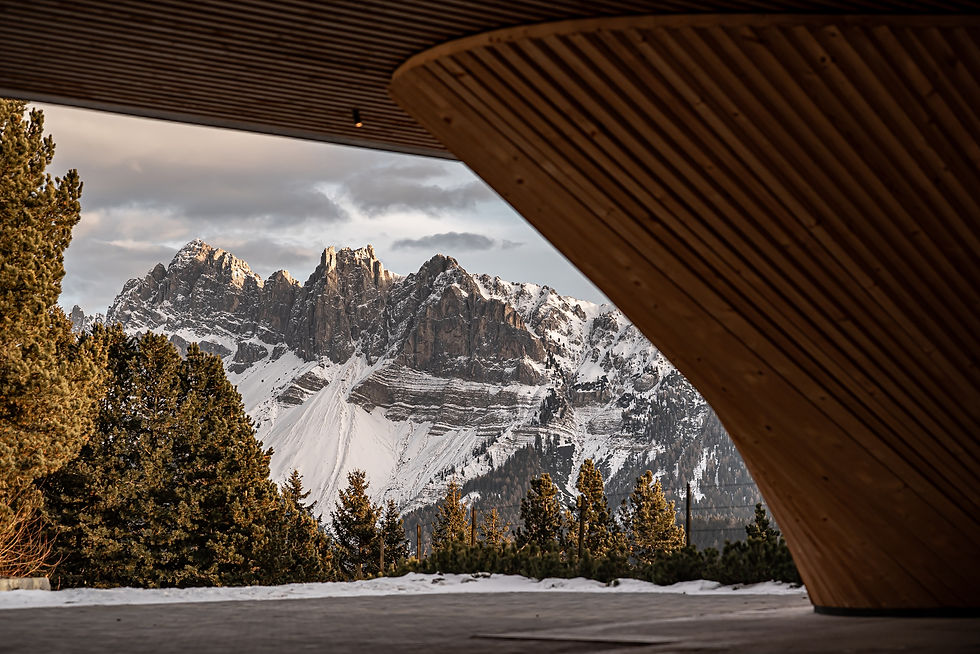
Above the village of Funes in South Tyrol, Anders Mountain Suites offers one of the most striking views in the Dolomites. Designed by architect Martin Gruber, the seven-suite retreat frames the Odle peaks through sculptural timber volumes and expansive glass. Each suite is a duplex with a stunning mountain view, a private sauna, and direct access to nature.
Despite its architectural clarity, Anders remains deeply personal. Owner Andreas and his family have lived in the valley for generations, creating an atmosphere closer to a private alpine home than a hotel.
Evenings gather naturally around the table where Andreas himself prepares regional cuisine rooted in South Tyrolean traditions and seasonal ingredients.
Anders Mountain Suites has the most incredible views in the Dolomites Anders Mountain Suites has the most incredible views in the Dolomites Anders Mountain Suites has the most incredible views in the Dolomites Anders Mountain Suites has the most incredible views in the Dolomites Anders Mountain Suites has the most incredible views in the Dolomites Anders Mountain Suites has the most incredible views in the Dolomites Anders Mountain Suites has the most incredible views in the Dolomites Anders Mountain Suites has the most incredible views in the Dolomites Anders Mountain Suites has the most incredible views in the Dolomites Anders Mountain Suites has the most incredible views in the Dolomites Anders Mountain Suites has the most incredible views in the Dolomites Anders Mountain Suites has the most incredible views in the Dolomites Anders Mountain Suites has the most incredible views in the Dolomites
Why it makes our list: Few places in the Dolomites combine architectural clarity, genuine family hospitality, and such an intimate sense of place. With only seven suites and uninterrupted views of the Odle peaks, Anders captures the rare feeling of inhabiting the mountains rather than simply visiting them.


Eriro Alpine Hide —
Elemental Living Above Ehrwald
Accessible only by cable car, eriro Alpine Hide sits at 1,550 meters above Ehrwald at the edge of a forest clearing. With just nine suites and no televisions, the retreat invites guests into a slower rhythm where the surrounding landscape becomes the central experience.
Designed by architect Martin Gruber, the property is constructed almost entirely from wood, wool, and stone, creating an architecture that feels inseparable from the mountains.
Days move naturally between skiing, snowshoeing, and quiet hours beside the fire, while the kitchen prepares seasonal dishes guided by regional ingredients and open-fire cooking.
The Himil rooftop penthouse adds a dramatic dimension to the stay with floor-to-ceiling glass, a private sauna, a fireplace, a wooden bathtub, and a telescope for observing the alpine night sky.
eriro is an alpine hideaway shaped by stillness, craft, and elemental beauty eriro is an alpine hideaway shaped by stillness, craft, and elemental beauty eriro is an alpine hideaway shaped by stillness, craft, and elemental beauty eriro is an alpine hideaway shaped by stillness, craft, and elemental beauty eriro is an alpine hideaway shaped by stillness, craft, and elemental beauty eriro is an alpine hideaway shaped by stillness, craft, and elemental beauty eriro is an alpine hideaway shaped by stillness, craft, and elemental beauty eriro is an alpine hideaway shaped by stillness, craft, and elemental beauty eriro is an alpine hideaway shaped by stillness, craft, and elemental beauty eriro is an alpine hideaway shaped by stillness, craft, and elemental beauty eriro is an alpine hideaway shaped by stillness, craft, and elemental beauty eriro is an alpine hideaway shaped by stillness, craft, and elemental beauty eriro is an alpine hideaway shaped by stillness, craft, and elemental beauty eriro is an alpine hideaway shaped by stillness, craft, and elemental beauty
Why it makes our list: With only nine suites, cable-car access, and an architectural philosophy built from wood, wool, and stone, eriro offers a rare retreat where simplicity becomes the true luxury of the mountains.

Château de Raymontpierre —
A Hidden Castle in the Swiss Jura
Hidden within the quiet folds of the Jura Mountains, Château de Raymontpierre offers one of Switzerland’s most secluded historic retreats. Built between 1594 and 1596, the estate sits within 650 hectares of farmland, orchards, and woodland.
A recent restoration preserves the castle’s historic architecture while introducing restrained contemporary interiors across six suites in the château and eight rooms in the nearby La Grange.
Dining reflects the rhythms of the land itself. Guests often begin evenings with a walk through the gardens, gathering herbs and vegetables before returning to the château’s vaulted kitchen.
Meals unfold either around a communal outdoor table near the fire ring or within the château’s salons, where seasonal dishes reflect the surrounding landscape.
Château de Raymontpierre offers a unique castle hideaway in the mountains of Jura, Switzerland Château de Raymontpierre offers a unique castle hideaway in the mountains of Jura, Switzerland Château de Raymontpierre offers a unique castle hideaway in the mountains of Jura, Switzerland Château de Raymontpierre offers a unique castle hideaway in the mountains of Jura, Switzerland Château de Raymontpierre offers a unique castle hideaway in the mountains of Jura, Switzerland Château de Raymontpierre offers a unique castle hideaway in the mountains of Jura, Switzerland Château de Raymontpierre offers a unique castle hideaway in the mountains of Jura, Switzerland Château de Raymontpierre offers a unique castle hideaway in the mountains of Jura, Switzerland Château de Raymontpierre offers a unique castle hideaway in the mountains of Jura, Switzerland Château de Raymontpierre offers a unique castle hideaway in the mountains of Jura, Switzerland Château de Raymontpierre offers a unique castle hideaway in the mountains of Jura, Switzerland Château de Raymontpierre offers a unique castle hideaway in the mountains of Jura, Switzerland Château de Raymontpierre offers a unique castle hideaway in the mountains of Jura, Switzerland Château de Raymontpierre offers a unique castle hideaway in the mountains of Jura, Switzerland Château de Raymontpierre offers a unique castle hideaway in the mountains of Jura, Switzerland
Why it makes our list: With only a handful of rooms and hundreds of hectares of surrounding landscape, Raymontpierre offers one of Switzerland’s most secluded historic estates. Its blend of architectural heritage, ecological restoration, and deeply seasonal cooking creates an experience that feels both intimate and timeless.

Cabane Tortin —
A Private Alpine Observatory Above Verbier
At nearly 3,000 meters beneath Mont Fort, Cabane Tortin occupies one of the most dramatic locations in the Swiss Alps. Skiers reach the cabin across the high terrain of the 4 Vallées, carving through wide snowfields before arriving at the ridge.
The structure’s cantilevered architecture frames sweeping views across glaciers and alpine bowls, while interiors combine pale timber, soft textiles, and a suspended fireplace that anchors the living space.
By night, the surrounding mountains fall into darkness, revealing extraordinary clarity in the alpine sky, transforming the cabin into a true mountain observatory. Guests return from the slopes to a private chef preparing alpine dishes paired with Valais wines while the wind moves quietly across the ridge outside.
Cabane Tortin is one of the most exclusive ski cabin in the Alps Cabane Tortin is one of the most exclusive ski cabin in the Alps Cabane Tortin is one of the most exclusive ski cabin in the Alps Cabane Tortin is one of the most exclusive ski cabin in the Alps Cabane Tortin is one of the most exclusive ski cabin in the Alps Cabane Tortin is one of the most exclusive ski cabin in the Alps Cabane Tortin is one of the most exclusive ski cabin in the Alps Cabane Tortin is one of the most exclusive ski cabin in the Alps
Why it makes our list: With its knife-edge location beneath Mont Fort, striking contemporary architecture, and direct access to some of the most exhilarating ski terrain in Switzerland, Cabane Tortin stands as one of the Alps’ most extraordinary high-altitude refuges.
The Alps remain one of Europe’s most enduring landscapes for imagination and retreat. From radical architectural sanctuaries and intimate mountain lodges to historic estates and high-altitude refuges, these places reveal how alpine hospitality continues to evolve through design, gastronomy, wellness, and a deep sense of place. Together, they offer a compelling portrait of the mountains today, timeless in spirit, yet constantly being reinterpreted.


Comments