


Zurich by Design: An Insider’s Living Journey Through the World’s Most Livable City


Zurich does not seek your attention—it waits for your awareness. To the hurried eye, it is pristine, efficient, and almost restrained. But to those who slow down and walk its cobblestone spine along the Limmat and lakefront, a different Zurich begins to reveal itself: one built not on spectacle, but on quiet precision. Light glides across limestone façades. Medieval guild houses stand in dialogue with modernist interventions. Behind every archway and beneath every vaulted ceiling, design doesn’t perform—it breathes.
Zurich’s beauty doesn’t begin or end at the lake; it runs deeper—into its foundations, beneath its arches, through the geometry of its windows and the rhythm of its streets. This is a city where design is not decoration but DNA. Culture, architecture, and daily ritual are layered with intentionality, not to be consumed at a glance, but to be encountered slowly, in gestures and details. Zurich moves with a subtle brilliance: in the curve of a reading room dome, in the stillness of stone meeting glass, in the way history is not placed on display, but lived with grace.
The view by Limmat River Santiago Calatrava’s law library in Zurich University Lakefront living at Alex Lake Zurich Pavillon Le Corbusier Iconic B2 Hotel Lobby Baur's at Baur au Lac
This is not a city of surface impressions. It is a place of considered forms and quiet radicalism—where innovation rises from heritage with clarity and restraint. To walk through Zurich is to move through a living archive of European modernity and Swiss craftsmanship, where past and future exist not in contrast, but in continuous conversation.
This guide was created from that lived perspective, not observed from afar, but experienced through return visits, personal connections, and insider access. What follows is not a checklist, but a curated journey into the spirit of Zurich: a visual and architectural narrative for those who seek meaning, not just beauty, and a deeper passage into one of Europe’s most quietly extraordinary cities.


Old Town & The Limmat
Storchen Zürich: The River as Arrival, Heritage as Living Design
I always begin at Storchen, not as a guest, but as someone returning to a familiar threshold. The salmon-pink façade has greeted travelers for over six centuries, yet it never feels historic; it feels alive. First documented in 1357, the hotel is one of Zurich’s oldest continuously operating establishments. Once a boathouse welcoming travelers by water, today it remains symbolically tethered to the river, with its private dock still offering a romantic, gondola-like arrival that nods to its Venetian soul.
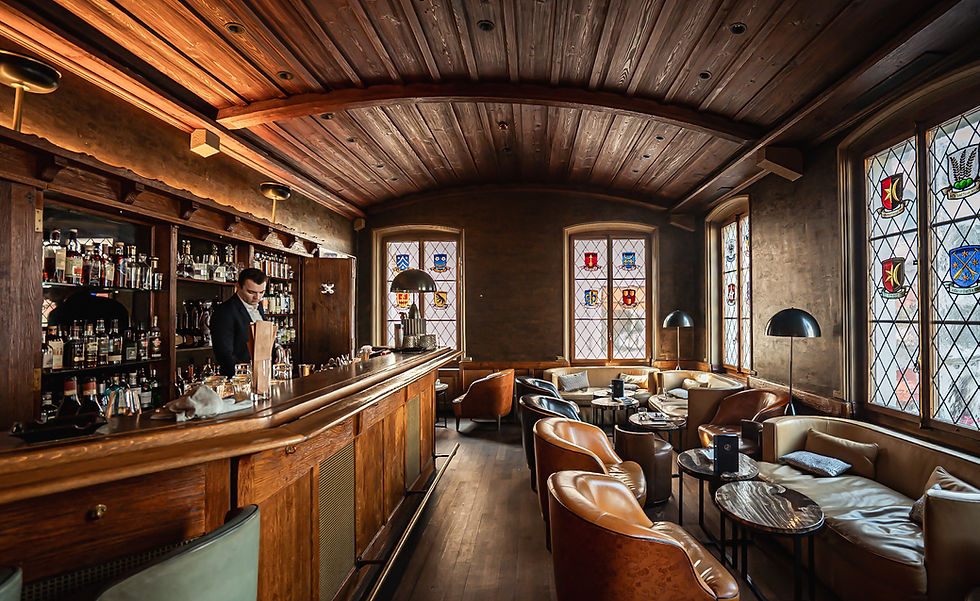
Stepping onto that dock is like crossing into the soul of the city. Inside, the atmosphere is one of refined stillness. Storchen is not ostentatious; it is assured. Wood-beamed ceilings, stained glass glass fixtures in the iconic Cigar Bar, river reflections dancing across polished parquet—every detail speaks Zurich’s language of heritage modernism, where history is not preserved behind velvet ropes, but seamlessly integrated into daily life.
My room opened directly above the Limmat. Dawn arrived not as light, but as geometry: church spires, rooftops, bridges, a city quietly assembling itself in gold. Breakfast unfolded as ritual: local honey from Storchen’s rooftop hives, Swiss cheeses, freshly baked Zopf, the morning boats gliding past like chapters turning softly on the river. The Nest rooftop bar not only produces honey for the hotel but also offers the best vantage point along the Limmat, overlooking the entire Old Town and the clock tower of St. Peter.
Storchen is where the story of Zurich begins—not because it is historic, but because it is alive. It is architectural memory made with memories from generations.
The Nest rooftop bat at Storchen The private dock at Storchen Zurich Dining room at La Rotisserie at The private dock at Storchen Zurich The private dock at Storchen Zurich Storchen Zurich Breakfast at Storchen Zurich Private dining at Storchen Zurich Cigar Bar at Storchen Zurich Barchetta Bar at Storchen Zurich Stay at Storchen Zurich La Rotisserie at Storchen Zurich
Walking Into Time: Zurich’s Living Architecture
Leaving Storchen’s riverside dock, we follow the curve of the Limmat, where the water moves like a quiet metronome, guiding the rhythm of the city. Here, Zurich is not a destination to be observed; it is a living structure you move through. Medieval guild houses lean toward the river with poetic certainty, their façades whispering centuries of craftsmanship and civic pride. Ornamental ironwork, carved lintels, painted coats of arms, these are not embellishments, but stories rendered in architecture.
We wander into the narrow arteries of the Old Town, where every turn reveals another dialogue between eras. Roman foundations lie beneath Renaissance guildhalls; Gothic spires rise beside Bauhaus lines. Whether you admire the twin-towered Grossmunster Cathedral, or discover the traditional culinary gem beneath the cave at Wystube Isebähnli, the city is a palimpsest, each layer shaping the next with restraint and confidence. Zurich does not tell its story all at once. It reveals it, stone by stone, to those who walk slowly enough to notice.
Cruise through the Zurich Old Town Cruise through the Zurich Old Town Cruise through the Zurich Old Town

Giacometti-Halle: The Ceiling That Breathes Light
Tucked inside the city’s police headquarters is one of Zurich’s most astonishing secrets: the Giacometti-Halle. Painted in 1925 by Augusto Giacometti, this vaulted entrance hall is a masterpiece of color and transcendence. Florals, stars, and sacred motifs bloom across the ceiling in brilliant hues of red, blue, and gold—transforming a civic space into a dreamscape of light.
To stand beneath it is to feel uplifted. Known as The Flower Hall, the space is not grand in size, but in intention. It reminds us that beauty in Zurich is not always monumental—it is integrated into the rituals of daily life. Justice, administration, civic order—all presided over by color and light.
Giacometti-Halle by Augusto Giacometti Giacometti-Halle by Augusto Giacometti Giacometti-Halle by Augusto Giacometti

Santiago Calatrava’s Law Library: From History into Vision
.
Hidden within the University of Zurich, Santiago Calatrava’s law library rises like an illuminated spine of knowledge. The space is an oval atrium, wrapped in pale wood ribs that curve upward into a glowing skylight. There are no hard edges, only shapes and movement. Light pools at the top and flows gently down the walls, like thought traveling through the mind.
Bookshelves form terraces of intellect. Silence moves with a sacred stillness. For us, it is an architectural meditation on order, clarity, and intellectual pursuit. Not only is this a must-see architectural spectacle that inspires many, but this is Zurich’s identity elevated into form, modernism cradled within heritage, vision grounded in discipline.
The law library at University of Zurich The law library at University of Zurich The law library at University of Zurich
IGNIV Zürich by Andreas Caminada: Where Gastronomy Becomes Architecture
As evening descends, we arrive at IGNIV Zurich—meaning “nest” in Romansh—a culinary sanctuary that embodies the architectural intimacy of Zurich’s spirit. Designed as a space for connection, not performance, the restaurant invites guests into elegant warmth: velvet textures, curved banquettes, glowing sconces. There are no theatrical flourishes—everything is designed to draw you inward.
Chef Andreas Caminada’s philosophy is rooted in sharing. The tasting menu unfolds in curated courses designed to be passed across the table—food as architecture of human connection. The flavors are precise yet deeply comforting, contemporary yet nostalgic. It is less a meal than a conversation—a design of taste, memory, and togetherness.
Whimsical dining experience at IGNIV Zürich by Andreas Caminada Whimsical dining experience at IGNIV Zürich by Andreas Caminada Whimsical dining experience at IGNIV Zürich by Andreas Caminada
Lakeside Grandeur & Design Living
Leaving the intimacy of the Old Town, the city opens toward the lake, its horizon widening, its architectural language shifting from medieval stone to modernist glass and steel. Here, Zurich steps into its role not just as a guardian of history, but as a curator of the future. Light becomes a building material. Water becomes a mirror. Architecture speaks in gestures of clarity, restraint, and visionary intent.
La Réserve Eden au Lac — Philippe Starck’s Imaginary Yacht Club La Réserve Eden au Lac — Philippe Starck’s Imaginary Yacht Club La Réserve Eden au Lac — Philippe Starck’s Imaginary Yacht Club La Réserve Eden au Lac — Philippe Starck’s Imaginary Yacht Club La Réserve Eden au Lac — Philippe Starck’s Imaginary Yacht Club La Réserve Eden au Lac — Philippe Starck’s Imaginary Yacht Club
La Réserve Eden au Lac — Philippe Starck’s Imaginary Yacht Club
Arriving at La Réserve Eden au Lac feels like stepping onto a modern vessel gently anchored to Swiss heritage. Designed by Philippe Starck, the space is not merely renovated but reimagined as a floating world of poetic precision—where every angle, material, and shadow is part of a story about light, water, and time.
Polished walnut, Carrara marble, leather-bound railings, and brass accents recall maritime travel with a touch of cinematic nostalgia. Morning light pours across the terrace in golden bands, casting reflections that move like oars across the lake. Breakfast becomes a ritual of stillness—fresh figs, warm croissants, soft morning breeze.
Late afternoon is when the famous La Muna rooftop bar comes alive—not with noise, but with perspective. This is when Zürich’s sky begins painting itself in layers of gold and rose, the Alps forming a faint silhouette on the horizon. Glass in hand, you witness the city in its most contemplative moment. Church spires, sailboats, the gentle hush of evening descending—all reflected against the water like a living canvas. This is Zurich at its most cinematic: not performed, but revealed.
La Réserve Eden au Lac — Philippe Starck’s Imaginary Yacht Club La Réserve Eden au Lac — Philippe Starck’s Imaginary Yacht Club La Muna at La Réserve Eden au Lac La Muna Rooftop at La Réserve Eden au Lac La Réserve Eden au Lac Stained glass by Ara Starck at La Réserve Eden au Lac
As dusk settles, you descend into the warm glow of Eden Kitchen, where La Réserve’s visual poetry transitions into gastronomic expression. Surrounded by stacked firewood walls and natural textures, the energy shifts from panoramic to intimate.
Executive Chef Marco Ortolani brings a philosophy rooted in authenticity and terroir-driven elegance. With one Michelin star and 16 Gault & Millau points, Eden Kitchen crafts dishes that are both restrained and deeply evocative: Herb-Roasted Beetroot Carpaccio with almonds and truffle emulsion, a quiet masterpiece of earth and elegance. Chamois Ravioli with quince and hibiscus, a sensory dialogue between the land and memory. Here, cuisine becomes architecture, each plate structured with intention, every flavor revealing a place, a season, a story.
Eden Kitchen at La Réserve Eden au Lac Eden Kitchen at La Réserve Eden au Lac Eden Kitchen at La Réserve Eden au Lac Eden Kitchen at La Réserve Eden au Lac Eden Kitchen at La Réserve Eden au Lac Eden Kitchen at La Réserve Eden au Lac Eden Kitchen at La Réserve Eden au Lac Eden Kitchen at La Réserve Eden au Lac Eden Kitchen at La Réserve Eden au Lac

From Lakefront Sanctuary to Pavillon Le Corbusier
Leaving the warm glow of Eden au Lac, we step back into the open air, where twilight has turned the lake into a mirror of molten silver. The path along the Zürichhorn is not simply a promenade—it is a slow immersion into the city’s deeper creative psyche, where art, nature, and architecture meet in quiet dialogue. We walk past the iconic Henry Moore sculpture, its bronze curves catching the last light of day. The sound of lapping waves against the shore replaces conversation. Zürich, in these moments, speaks its truest language: silence articulated through design.
Just beyond the trees emerges Pavillon Le Corbusier, Le Corbusier’s final built work and his only project fully executed in glass and steel. Floating above the lawn like a piece of functional sculpture, the pavilion is an exploration of proportion, color, material, and light. Each pane of glass, each steel panel, is calibrated according to the architect’s Modulor system, his lifelong pursuit of a universal harmony between human scale and architectural form.
Inside, natural light bends across chromatic surfaces; reflections ripple in glass; the lake outside becomes part of the interior’s shifting geometry. You don’t simply look at this structure; you feel it recalibrating your sense of space, rhythm, and time.

Baur au Lac – Where Zurich’s History Meets Its Future
Toward the heart of the city, the promenades lead to palatial hotels, gardens become galleries, and culinary spaces act as cultural salons for Europe’s thinkers, artists, financiers, and dreamers. This is the realm of Baur au Lac, a name synonymous not only with luxury, but with legacy. Opened in 1844, Baur au Lac has hosted kings, Nobel laureates, and artists, but entering its grounds does not feel like stepping into the past—it feels like being welcomed into a private world where discretion and design speak louder than grandeur. This is Zurich at its most cultivated: restrained, intelligent, deeply rooted in excellence.
Within this legendary setting sits Baur’s, the hotel’s brasserie, as reimagined by Martin Brudnizki, the vision behind London’s Annabel’s and Broadwick Soho. Step through its lacquered wood doors and the atmosphere changes: velvet banquettes, mirrored ceilings, jewel-toned palettes, and contemporary art create an ambiance that is both cosmopolitan and emotionally warm.
This is where Zurich gathers—not to be seen, but to belong. The cuisine reinterprets European classics with precision and modern edge: Filet de boeuf with alpine herbs; Delicate seafood from Zurich’s lake region; The signature millefeuille—a study in architectural pastry. Each plate is a continuation of the hotel’s ethos: elegant, intentional, quietly extraordinary.
Adjacent to Baur’s lies Marguita, a airy gem that feels like a private dining room of Zurich’s cultural elite. Candlelit, with deep green marble, sculptural lighting, and a menu inspired by the Mediterranean basin, it is a space designed not for spectacle, but for conversation.
Here, dishes travel from Provence to Sicily to the Levant—anchored always by Swiss terroir and seasonal precision. Marguita is the whisper to Baur’s brasserie-like hum: a space for stories, ideas, and slow-burning inspiration.
Baur’s by Martin Brudnizki at Baur au Lac Baur’s by Martin Brudnizki at Baur au Lac Baur’s by Martin Brudnizki at Baur au Lac Baur’s by Martin Brudnizki at Baur au Lac

Bar am Wasser — Where Mixology Becomes a Design Ritual
If Baur au Lac is Zurich’s legacy and La Réserve its dreamscape, Bar am Wasser is its pulse.
Tucked discreetly beside the lake, without signage or spectacle, the bar glows like a secret shared only by those who understand that luxury is not volume, but vibration. Light bounces off marble counters and sculpted glass. There is no clutter, no distraction, only form, function, and the alchemy of liquid craft.
Behind the bar, the team moves like a choreography of precision. There is no menu in the traditional sense; instead, cocktails are composed from conversation—tailored to mood, memory, even the weather outside. The palette: muted stone, polished brass, lake reflections flickering on glass. The mood: hushed, attentive, restorative. Bar am Wasser is not the end of a night—it is an arrival. A space where Zurich’s intellectual and creative circles gather not to drink, but to connect.
Photo Courtesy by Bar am Wasser Photo Courtesy by Bar am Wasser Photo Courtesy by Bar am Wasser
Zurich West — The Industrial Renaissance
Where the city’s future is being built from its own bones
Zurich West is where the city shifts its rhythm, away from the lake’s reflective stillness into a realm of brick, steel, locomotion, and reinvention. This is where the industrial past hasn’t been erased, but reimagined: viaducts transformed into cultural arteries, factories reborn as wellness sanctuaries, and abandoned infrastructure turned into culinary and creative ateliers.
We continue into the district, past brick warehouses transformed into galleries and design studios. Every corner hints at reinvention. There are no billboards or neon declarations, only the quiet confidence of a city shaping its future through thoughtful reuse, material intelligence, and cultural intention.

IM VIADUKT — Living Beneath the Arches of Time
We enter beneath the arches of IM Viadukt, where 19th-century stone once carried freight trains and now carries the heartbeat of Zurich’s creative class. Boutique ateliers display Swiss-made ceramics, textile experiments, and contemporary furniture as if each arch were a page in Zurich’s ongoing design manifesto.
In the Markthalle, the scent of alpine cheeses, heirloom produce, and biodynamic wines fills the vaulted arcade—sustainability here is not a lifestyle trend, but the natural evolution of Swiss craftsmanship. Beyond the arches, warehouses open into galleries where art isn’t merely exhibited—it is debated, prototyped, and lived.
Zurich West is not performing modernity; it is actively inventing it.
IM Viadukt in West Zurich IM Viadukt in West Zurich IM Viadukt in West Zurich IM Viadukt in West Zurich IM Viadukt in West Zurich IM Viadukt in West Zurich
Restaurant KLE — Gastronomy as Design Philosophy
At the heart of this creative district is Restaurant KLE, where plant-based cuisine becomes a medium of architectural thought.
Chef Zineb “Zizi” Hattab, an engineer turned chef, composes dishes with structural clarity. Each plate is deliberate: Moroccan memory, Swiss purity, global method. Nothing is ornamental; everything is essential.
Ingredients are sourced within 60 kilometers, forming a closed-loop ecosystem that mirrors Zurich’s sustainable future. The dining room itself feels more like a design studio than a restaurant, intimate, elemental, purpose-driven. To dine at KLE is not to consume, but to participate in a new philosophy of nourishment, quietly radical, deeply intentional.
Restaurant KLE Restaurant KLE Restaurant KLE Restaurant KLE Restaurant KLE Restaurant KLE

B2 Hotel & Thermalbad & Spa — Wellness in the Bones of Industry
Zurich West’s final revelation lies inside a former Hürlimann brewery, now home to the B2 Boutique Hotel and the Thermalbad & Spa, a cathedral of water carved from the industrial past.
Bathing pools are set within old brewing vats, their iron skeletons left exposed as if to remind you: transformation is Zurich’s truest luxury. Arched brick chambers echo gently with thermal water; stone, steel, and steam form a symphony of restoration.
Then comes the ascent: the rooftop pool. You emerge into open sky, Zurich’s rooftops, steeples, and rail lines unfolding in every direction, thermal steam rising like memory. This is a great example of a genius transformation of a space of production into a sanctuary of renewal. Industry reborn into ritual. The past not replaced, but reimagined.
B2 Hotel and the Thermalbad & Spa in West Zurich B2 Hotel and the Thermalbad & Spa in West Zurich B2 Hotel and the Thermalbad & Spa in West Zurich

Lake Zurich Escapes & Elevated Nature
Leaving Zurich’s urban rhythm, the city doesn’t end—it exhales. As the tram ascends toward the Zürichberg, stone gives way to forest, and the air shifts from architectural to elemental. This is where Zurich reveals its elevated self: not through spectacle, but through serenity. Architecture no longer frames the city—it frames horizon, water, forest, and sky.
Here begins a different expression of luxury: one defined not by display, but by atmosphere. By stillness. By the art of refuge.
The Dolder Grand — Where Art, Nature, and Culinary Imagination Collide
As the tram climbs into the forested slopes of the Zürichberg, The Dolder Grand rises not as a hotel, but as an architectural aperture, framing the sky, the lake, and the imagination. Here, every surface, every corridor, every culinary gesture contributes to a singular narrative: art and nature as living forces. The hotel houses one of the most important private art collections in Europe. A monumental work by Anish Kapoor bends light in the hallway; a playful sculpture by Takashi Murakami floats amidst alpine stillness. Pieces by Warhol, Dalí, and Barry Flanagan are not simply viewed, they are encountered, as if in conversation with the landscape beyond the glass.
In the summer season, energy gathers at Blooms, a garden restaurant suspended between sculpture and sky. Surrounded by living greenery and framed by a sculpture from Keith Haring, dining here feels like an immersion, each dish a translation of nature’s rhythm. Tomato and strawberry emerge in a surprising symphony of acidity and sweetness. Potato and cabbage are elevated into sculptural form, earthy, thoughtful, celestial. Every plate is grounded in the soil of Switzerland yet expressed with cosmopolitan imagination. Here, nature is revered as protagonist.
Descending into the Canvas Bar, light shifts, voices soften, and design becomes performance. Signature cocktails are crafted like installations—layered, architectural, often inspired by the surrounding artworks. With rich textures and curated art on the walls, the bar is not nightlife—it is cultural dialogue, distilled into liquid form.
The Dolder Grand is not a retreat from Zurich, this is where Zurich reveals its elevated self: a sanctuary where art is alive, cuisine listens to the land, and design becomes a quiet, enduring form of storytelling.
Blooms at The Dolder Grand Keith Haring & Blooms at The Dolder Grand Blooms at The Dolder Grand Blooms at The Dolder Grand The newly renovated Canvas Bar at The Dolder Grand The newly renovated Canvas Bar at The Dolder Grand

Alex Lake Zürich — Modern Serenity on the Water’s Edge
There are hotels by the lake, and then there are hotels that become the lake. Alex Lake Zürich belongs to the second category. Arriving by the hotel’s private boat, you are gently ferried across the still surface of Lake Zurich, city silhouettes fading behind you, water turning to a mirror. The moment the boat glides into the dock, you feel as though you’ve crossed into a quieter universe of existence.
Each suite frames the lake like a private cinema. Floor-to-ceiling windows dissolve the boundary between interior and horizon; the surface of the water becomes a moving canvas that shifts with every breath of wind. The aesthetic is pure, modernist clarity, parquet floors, clean lines, natural textures, yet softened by a residential warmth that encourages exhale, not performance.
What sets Alex apart is not only the amenity, but also access to the elemental. From the private deck, you can plunge directly into the lake at dawn, the water holding the shimmer of morning light. Paddleboards rest discreetly along the shoreline, waiting for those who want to greet the day in movement rather than words.
The arrival at Alex Lake Zürich Sunrise from Alex Lake Zürich Lakeside living at Alex Lake Zürich Alex Lake Zürich In-room Kitchenette at Alex Lake Zürich Alex Lake Zürich Penthouse Suite at Alex Lake Zürich Alex Lake Zürich Alex Lake Zürich
In summer, the terrace becomes an axis of light and leisure. Breakfast arrives as a quiet ritual of local fruit, Swiss yogurt, and freshly baked pastries served just above the waterline. The sky, water, architecture all held in delicate alignment.
The wellness sanctuary deepens this contemplative rhythm. Hammam wood, heated stone bed, and a vitality pool channel the minimalism onsen through Swiss sensibility. Each space is designed to strip away noise until only the essential remains: water against skin, breath in air, calm in motion.
The signature restaurant, The Alex, extends the hotel’s philosophy to the plate: Mediterranean-inspired, locally sourced, elegantly restrained. Heirloom tomatoes from local farms, lake fish seasoned with alpine herbs, olive oils from small Mediterranean groves: each dish is a quiet expression of place.
Staying at Alex Lake Zürich is not about escape; it is about recalibration. This is a rare moment of stillness that reminds you what ease can feel like when architecture listens to nature, hospitality honors silence, and arrival begins with the journey across the water.
Outdoor terrace at Alex Lake Zürich Private dock at Alex Lake Zürich Alex Lake Zürich The Alex at Alex Lake Zürich Spa lounge at Alex Lake Zürich Spa pool at Alex Lake Zürich

Restaurant Buech — Where Tradition Rises Above
Leaving the shoreline behind, the car begins to climb. The air cools as vineyards appear in gentle rows, and the city of Zurich slips slowly from view. At the top of the hill, embraced by old chestnut trees and the glow of early evening light, Restaurant Buech introduces itself quietly, the way true heritage always does: without performance, without spectacle, simply present.
There is no boat arrival here, no theatrical driveway. Just the gentle realization that you have stepped into one of Zurich’s most storied dining sanctuaries. I have so many memories here, including an intimate birthday celebration in one of the huts earlier this summer.
In warmer months, tables unfold beneath the canopy of chestnut leaves, the breeze carrying the scent of grass and vineyard earth. The terrace feels suspended, neither grounded nor airborne, but existing in its own layer between water and sky. The view stretches across Lake Zurich toward the snow-drawn edge of the Alps, turning every glance into a moment of contemplation.
In winter, the experience retreats inward, into intimate chalet-style rooms and modern dining huts that retain the romance of alpine heritage while embracing a contemporary design language. Inside, walls are adorned with artworks by Warhol, Basquiat, and European masters, pieces not displayed for prestige, but integrated into the architecture as if they belonged to the land itself. It feels like being invited into a private estate where time is honored, not rushed.
The cuisine is grounded in seasonality and locality: venison braised with wines from the surrounding vineyards, vegetables lifted straight from the hillside gardens. The cooking does not ask for attention; it commands trust. Flavors are clean, precise, deeply rooted in Swiss terroir, reflecting a culinary philosophy that understands restraint as a form of reverence.
Restaurant Buech is a special escape and the city’s elevated self, a place where the elements that define Zurich’s soul: art, nature, tradition, design, rise into full clarity. Under this roof, luxury is not about being seen, it is about being still, watching the last light fall across the lake with a glass of wine in hand, knowing you are exactly where the landscape intended you to be.
Private dining hut at Restaurant Buech Dishes at Restaurant Buech Restaurant Buech Restaurant Buech Dishes at Restaurant Buech Indoor dining room at Restaurant Buech Restaurant Buech The vinyard at Restaurant Buech The entrance at Restaurant Buech

A City That Rewrites Your Rhythm
Zurich is not a city you conquer in a weekend; it is a city that slowly rewires the way you see.
You arrive prepared to observe, and instead you find yourself absorbing. Days begin with lake swims beneath a sky the color of porcelain and end in candlelit salons where art & design lives alongside you. Time doesn’t rush, it aligns.
What makes Zurich one of the world’s most livable cities is not a statistic, but a sensation: the feeling that everything has been considered. Transport arrives the moment you need it. Public spaces are treated as extensions of the home. Craft and civility are not luxuries, but everyday expectations. Beauty is not ornamental, it is functional, democratic, and quietly omnipresent.
Zurich presents itself in gradients: from the river’s shimmery hush to the industrial renaissance of Zurich West; from the purity of Calatrava’s oculus to the warmth of a Michelin-starred dining room where conversation becomes architecture. It is a place where heritage and futurism do not compete; they collaborate.
By being here, you begin to measure luxury not by excess, but by ease. Not by being seen, but by belonging. You start choosing clarity over clutter, purpose over performance.
The city invites you not to consume, but to attune. It does not dazzle, it calibrates. It enters the bloodstream slowly, reshaping your sense of space, your pace of thought, and your understanding of what a life well-designed can truly feel like.
For those who travel not just to go somewhere, but to evolve, Zurich is not a destination.
It is a blueprint designed for living.


Comments